Openers · Sensors · Remotes
Garage Door Opener Repair in Lubbock, TX
When you press the button and nothing happens, or the door starts down and pops back up, the opener system is the usual suspect. Here’s how to narrow it down, what’s safe to check and when it’s time for a new opener.
What Garage Door Opener Repair Covers
Garage door opener repair diagnoses and fixes the motorized system that moves the door: the motor and logic board, the drive gear and chain, belt or screw, the trolley that connects to the door, the remotes and wall controls, and the safety sensors near the floor. A technician also checks that the door itself is balanced, because many “opener problems” are really a broken spring or a binding door.
Openers have more electronics than they used to: Wi-Fi modules, battery backups, keypads and rolling-code remotes. That makes them more capable, and gives them more ways to fail. The good news is that many faults are simple once diagnosed. For the bigger picture of how doors fail, our guide to Lubbock garage door repair explains how all the parts work together.
Chain, Belt, Screw and Wall-Mount Openers
| Drive type | How it works | Notes |
|---|---|---|
| Chain drive | Metal chain pulls the trolley along the rail | Durable and common; louder, especially in attached garages |
| Belt drive | Reinforced rubber belt instead of a chain | Much quieter; popular when bedrooms sit over the garage |
| Screw drive | Threaded steel rod turns to move the trolley | Few moving parts; can be sensitive to temperature swings |
| Wall-mount (jackshaft) | Motor mounts beside the door on the torsion shaft | Frees the ceiling; good for high ceilings and storage lifts |
| Direct drive | Motor travels along a fixed chain | Very quiet with few moving parts |
Brand matters less than people think. Most local technicians service the major brands, and many parts such as sensors, gears and remotes are available for the popular models. What matters more is age: an opener more than 15 years old may lack modern safety and security features, and parts can be hard to find.
Common Opener Problems and What They Usually Mean
| Symptom | Likely cause |
|---|---|
| Nothing happens at all | No power: tripped breaker or GFCI outlet, unplugged unit or failed board |
| Motor hums, door doesn’t move | Stripped drive gear, broken spring, or the trolley is disengaged |
| Door starts down, then reverses | Safety sensors dirty, blocked or misaligned, or close force set too low |
| Opener light flashes and door won’t close | Sensor fault code; check both sensor lights |
| Remote doesn’t work, wall button does | Dead remote battery, lock mode on, or remote needs reprogramming |
| Door stops partway up | Travel limit out of adjustment, binding door or a weak spring |
| Grinding or loud chattering | Worn gear, loose chain, or the rail is loose from the ceiling |
Safety Sensors: The Most Common “Broken Opener” in Lubbock
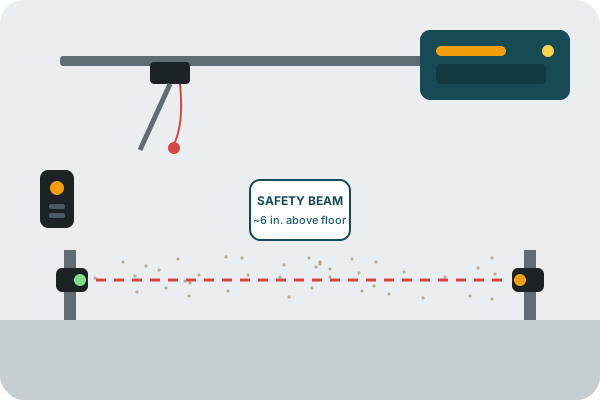
Since the early 1990s, residential garage door openers sold in the U.S. have had to include an automatic reversing system with external entrapment protection, usually a pair of photo-eye sensors mounted about six inches above the floor on each side of the door. One sends an invisible beam, the other receives it. If anything breaks the beam while the door is closing, the opener reverses.
That’s a vital safety feature, and it’s also the most common reason a door refuses to close. In Lubbock, a few local conditions make it worse. Dust coats the lenses after every windy day. Low sun in winter mornings and evenings can shine straight into a west- or east-facing sensor and blind it. And sensors get bumped by bikes, trash cans and lawn equipment, knocking them out of line.
- Look at both sensors. Most have a small LED; a steady light on each usually means they’re aligned.
- Wipe both lenses with a soft, dry cloth.
- Clear anything in the path, including cobwebs, leaves or items stored near the door.
- If one light is blinking or off, gently realign the bracket until it stays steady.
- If sun glare is the issue, a technician can swap the sensor sides or add a shade.
Taping sensors together or holding the wall button to override them removes the protection that stops a door from closing on a child or pet. If the sensors keep failing, get them repaired or replaced.
Safe Checks Before You Call
- Check that the opener is plugged in and that the outlet, breaker or GFCI hasn’t tripped.
- Try the wall button. If it works and the remote doesn’t, replace the remote battery.
- Make sure the lock or vacation mode on the wall control isn’t turned on.
- Look at the trolley on the rail. If the emergency release was pulled, the door is disconnected from the opener.
- Look up at the springs. If one is broken, stop and read the spring repair guide before going further.
If the door is crooked or off its rollers, don’t run the opener at all. See off-track garage door repair.
What the Technician Checks
- Door balance with the opener disconnected, to rule out a spring or cable problem.
- Power and controls: outlet, wiring to the wall button and the logic board.
- Drive system: gear, sprocket, chain or belt tension and the trolley.
- Sensors and wiring: alignment, lens condition and damaged low-voltage wires.
- Travel limits and force so the door closes fully and reverses on contact.
- Safety-reverse test with a 2x4 laid flat under the door before they leave.
Repair or Replace the Opener?
Many openers are worth repairing: a stripped gear, a failed sensor, a worn belt or a bad remote is a routine fix. Replacement makes more sense when:
- The opener is roughly 15 years old or more, and the logic board or motor has failed.
- Parts for the model are no longer available.
- It lacks rolling-code security, so remotes use a fixed code that is easier to copy.
- You want a quieter belt drive, a wall-mount unit, battery backup for power outages, or smartphone control.
- The door has been replaced with a heavier insulated model the old opener struggles with.
Battery backup is worth considering in Lubbock, where spring and summer storms can knock out power and leave a car stuck behind a closed door. If you’re also replacing the door, see new garage door installation.
What Affects the Cost of Opener Repair
| Factor | How it changes the price |
|---|---|
| Which part failed | A sensor or remote costs far less than a logic board or motor. |
| Opener age and brand | Parts for older or less common models can be hard to source. |
| Drive type | Belt, screw and wall-mount parts differ in price. |
| Wiring repairs | Damaged low-voltage wiring to sensors or the wall button adds labor. |
| Door condition | A broken spring or binding door must be fixed first. |
| New features | Battery backup, Wi-Fi and keypads add to a replacement price. |
FAQ
Garage Door Opener Questions
Why does my garage door opener click but not open?
A click usually means the board is getting the signal but the motor can’t move the door. Common causes are a broken spring, a stripped drive gear, a failed capacitor or motor, or a disengaged trolley. Check the springs first, then call a technician.
How do I reprogram a garage door remote?
Most openers have a learn button on the motor unit. Pressing it and then the remote button pairs them, but the exact steps vary by brand and model. Check the label on the opener or the manual. If the remote still won’t pair, the receiver or board may need attention.
Why won’t my garage door close all the way?
Usually the safety sensors are blocked, dirty or misaligned, or the down travel limit needs adjustment. Debris on the floor or in the track can also stop it. Check the sensor lights and clear the path first.
How long do garage door openers last?
Many openers last 10 to 15 years with normal use, sometimes longer. Heavy use, an unbalanced door and power surges shorten that. Older units also lack newer safety and security features.
Can a power outage damage my opener?
Power surges during storms can damage logic boards. A surge protector helps. During an outage, you can disconnect the door with the emergency release and open it by hand, but only if the springs are intact and the door is closed.
Is a belt drive better than a chain drive?
Belt drives are much quieter, which matters with rooms above or beside the garage. Chain drives are durable and usually cost less. Both lift a balanced door well.
Talk to a local garage door tech
Opener acting up? Talk to a local technician.
One free call connects you with an independent garage door company that repairs and replaces openers in Lubbock.
(806) 555-0163